
IGCSE · Physics · Past papers · Paper 1 (Multiple Choice)
Answer Key
Need more than one subject? All-notes pass: unlimited downloads of every note for a year: unlimited downloads of every note on the site, PKR 999 a year. All packs and courses.
Opens inside this page. Prefer your own PDF app? Open the PDF.
Check yourself
5 quick questions on IGCSE Physics
Tap an answer to see if you are right, and why. Free, no sign-up.
Start the free testNew · free
O Level Physics written answers, marked like a real examiner
Answer a Paper 2 style question by typing or speaking. You get your mark point by point, what the examiner was looking for that you missed, and a model answer. 5 free answers a day with a free account.
Try a written question👍 33 students found these notes useful
Was this note useful?
Full text of Answer Key
www.megalecture.com · www.youtube.com/@megalecture
Fahad H. Ahmad
M.Eng NUS Singapore · B.Eng NUST · 15+ years of teaching experience in Singapore, UAE & Pakistan · 60,000+ subscribers and 20 million+ video lecture views.
IGCSEPHYSICS0625·TOPICALPASTPAPERS
Pressure — Paper 1
Worked Answer Key (Multiple Choice)
Free notes, practice tests and live classes Back to megalecture.com
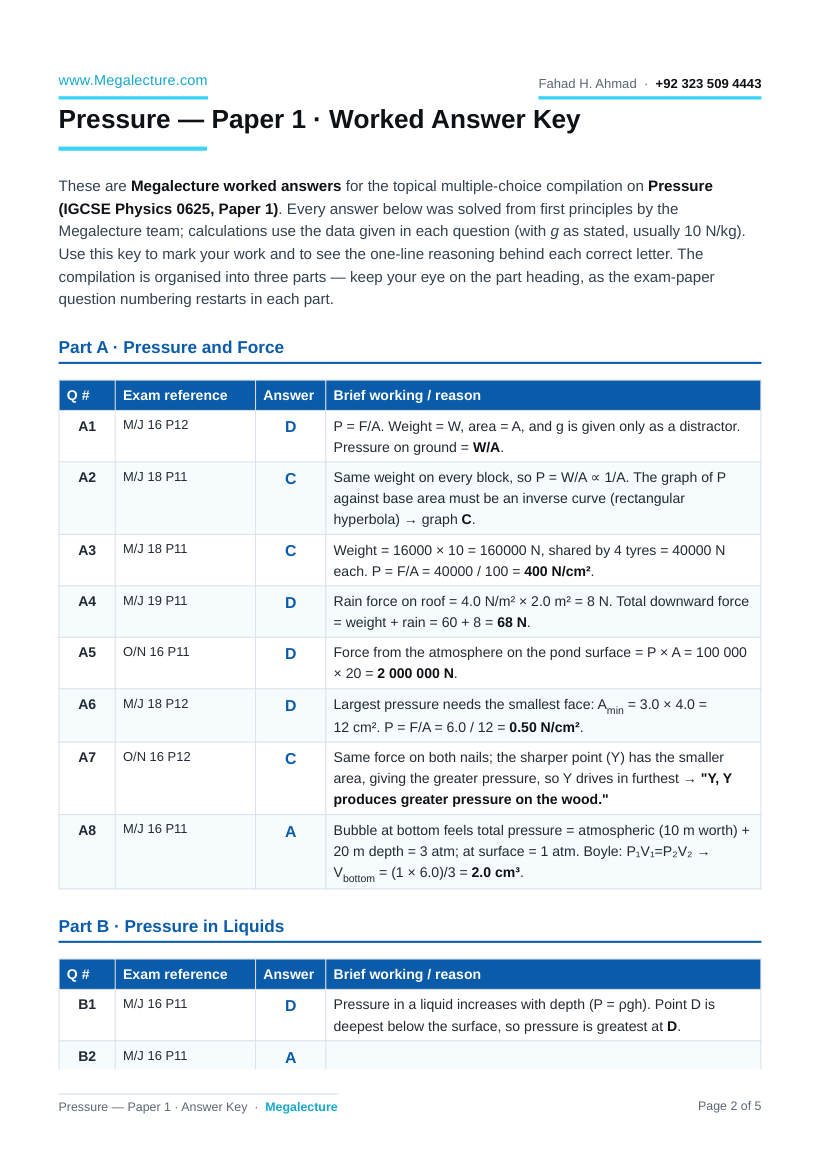
Pressure — Paper 1 · Worked Answer Key
These are Megalecture worked answers for the topical multiple-choice compilation on Pressure
(IGCSE Physics 0625, Paper 1). Every answer below was solved from first principles by the
Megalecture team; calculations use the data given in each question (with g as stated, usually 10 N/kg).
Use this key to mark your work and to see the one-line reasoning behind each correct letter. The compilation is organised into three parts — keep your eye on the part heading, as the exam-paper question numbering restarts in each part.
Part A · Pressure and Force Q # Exam reference Answer Brief working / reason A1
M/J 16 P12
D
P = F/A. Weight = W, area = A, and g is given only as a distractor.
Pressure on ground = W/A.
A2
M/J 18 P11
C
Same weight on every block, so P = W/A ∝ 1/A. The graph of P against base area must be an inverse curve (rectangular hyperbola) → graph C.
A3
M/J 18 P11
C
Weight = 16000 × 10 = 160000 N, shared by 4 tyres = 40000 N each. P = F/A = 40000 / 100 = 400 N/cm².
A4
M/J 19 P11
D
Rain force on roof = 4.0 N/m² × 2.0 m² = 8 N. Total downward force
= weight + rain = 60 + 8 = 68 N.
A5
O/N 16 P11
D
Force from the atmosphere on the pond surface = P × A = 100 000
× 20 = 2 000 000 N.
A6
M/J 18 P12
D
Largest pressure needs the smallest face: Amin = 3.0 × 4.0 =
12 cm². P = F/A = 6.0 / 12 = 0.50 N/cm².
A7
O/N 16 P12
C
Same force on both nails; the sharper point (Y) has the smaller area, giving the greater pressure, so Y drives in furthest → "Y, Y
produces greater pressure on the wood." A8
M/J 16 P11
A
Bubble at bottom feels total pressure = atmospheric (10 m worth) +
20 m depth = 3 atm; at surface = 1 atm. Boyle: P₁V₁=P₂V₂ →
Vbottom = (1 × 6.0)/3 = 2.0 cm³.
Part B · Pressure in Liquids Q # Exam reference Answer Brief working / reason B1
M/J 16 P11
D
Pressure in a liquid increases with depth (P = ρgh). Point D is deepest below the surface, so pressure is greatest at D.
B2
M/J 16 P11
A
Pressure — Paper 1 · Answer Key · Megalecture
Q # Exam reference Answer Brief working / reason
10 m of water = 1 atm, so a 20 m lake gives total 1 + 2 = 3 atm at the bottom, 1 atm at the surface. Boyle: Vbottom = (1 × 6.0)/3 =
2.0 cm³.
B3
M/J 17 P11
B
X and Y are at the same depth → same pressure (a liquid finds its own level). Z is deeper than X → pressure at X is lower than Z. So
X = Y, X < Z → "same as Y, the same / lower vs Z" = row B.
B4
M/J 17 P11
B
Gas gauge pressure = ρgh = 1000 × 10 × 0.20 = 2000 Pa.
B5
M/J 17 P12
B
P = ρgh with same h and same g, so the only thing that can differ is the liquid: the densities of the liquids are different.
B6
M/J 18 P11
A
Atmospheric pressure = ρgh of the mercury column = vertical height from the mercury surface in the dish up to the top of the column → height A.
B7
M/J 19 P11
A
Up a mountain the air is thinner, so atmospheric pressure is lower;
it can support a shorter mercury column → h decreases because atmospheric pressure decreases with height.
B8
M/J 19 P11
A
Δh = ΔP/(ρg) = 5600 / (14000 × 10) = 0.040 m = 40 mm.
B9
M/J 20 P11
D
Total P = atmospheric + ρgh = 100000 + (1000 × 10 × 15) =
100000 + 150000 = 250 000 Pa.
B10
M/J 20 P11
D
Mercury in the open arm stands higher than in the gas arm, so the gas pressure exceeds atmospheric. P = atmospheric + level difference = 756 + 80 = 836 mm of mercury.
B11
M/J 20 P12
D
Greatest pressure = largest ρ × h. Compare ρh: A 4000, B 10000,
C 4800, D 12000. Largest is D (1200 × 10) → D.
B12
O/N 16 P11
D
P = ρgh = (8.5 × 10²) × 10 × 6.0 = 850 × 60 = 51 000 Pa.
B13
O/N 16 P12
D
Gas gauge pressure = ρg × (height difference between the two mercury surfaces) = distance D.
B14
O/N 17 P11
C
Level difference = 0.60 − 0.20 = 0.40 m. ΔP = ρgh = 14000 × 10 ×
0.40 = 56 000 Pa.
B15
O/N 18 P11
C
P = sealed top, Q = top of mercury, R = mercury surface in the dish. The barometric height that measures atmospheric pressure is
QR. When atmospheric pressure decreases the supported column shortens, so length QR decreases (and the vacuum gap PQ grows).
B16
O/N 18 P12
A
Pressure at the base = ρgh, so compare ρ × h (area is irrelevant). A
1.3×50 = 65, B 0.80×80 = 64, C 1.0×60 = 60, D 0.92×75 = 69.
Largest is D (69). Correct answer is D.
B17
O/N 19 P11
A
Total pressure at depth = atmospheric P + ρgh, which needs g, h, P and ρ → g, h, P and ρ.
Pressure — Paper 1 · Answer Key · Megalecture
Q # Exam reference Answer Brief working / reason B18
O/N 19 P12
C
The trapped air supports atmospheric pressure plus the water column above it; tube R has the longest (slanted) water column above the trapped air, giving the greatest depth h → greatest air pressure in R.
B19
O/N 20 P11
B
The open arm is higher than the gas arm by h, so the gas is above atmospheric: P = p₀ + hρg → p₀ + hρg.
B20
O/N 20 P12
C
Boyle: P₁V₁ = P₂V₂. Vsurface = (3.0×10⁵ × 0.60)/(1.0×10⁵) = 1.8 cm³.
Part C · Pressure in Gases Q # Exam reference Answer Brief working / reason C1
M/J 16 P11
A
(Same as B2.) Bottom = 3 atm, surface = 1 atm, Vsurface = 6.0.
Boyle → Vbottom = (1×6.0)/3 = 2.0 cm³.
C2
M/J 17 P12
D
Fixed mass at constant temperature obeys Boyle's law: P₁V₁ =
P₂V₂. So the correct relation is p₁V₁ = p₂V₂.
C3
M/J 18 P12
C
At altitude the outside (cabin/atmospheric) pressure is lower, so the trapped air expands the packet: the pressure of the air outside the packet decreases.
C4
M/J 19 P12
C
P doubles → V halves at constant T. Same mass in half the volume
→ density doubles (increases); T is unchanged → density increases, temperature remains constant.
C5
M/J 20 P12
B
Boyle: P₂ = P₁V₁/V₂ = (100 × 3.0)/12 = 25 kPa.
C6
O/N 16 P11
A
Pushing the piston in reduces the volume; at constant temperature
Boyle's law gives a higher pressure → pressure increases, volume decreases.
C7
O/N 17 P12
C
Boyle: V₂ = P₁V₁/P₂ = (1.0×10⁵ × 240)/(1.5×10⁵) = 160 cm³.
C8
O/N 18 P11
B
New length = 20 + 40 = 60 cm (volume tripled). Boyle: P₂ = p ×
20/60 = p/3.
C9
O/N 18 P11
C
Gas pressure arises from molecules colliding with and rebounding from the container walls → gas molecules collide with the walls of the container.
C10
O/N 19 P11
C
At constant T, P ∝ 1/V (Boyle), so the P–V graph is an inverse curve falling toward the axes → graph C.
C11
O/N 20 P12
C
(Same as B20.) Boyle: Vsurface = (3.0×10⁵ × 0.60)/(1.0×10⁵) =
1.8 cm³.
Pressure — Paper 1 · Answer Key · Megalecture
Note from Megalecture. A few items in this compilation appear twice across the "liquids" and "gases" parts (the lake- bubble and diver-bubble Boyle's-law questions). They are answered consistently above. These are original Megalecture worked solutions prepared for revision use.
Pressure — Paper 1 · Answer Key · Megalecture
