
A Level · Chemistry 9701 · Notes
Download
Need more than one subject? All-notes pass: unlimited downloads of every note for a year: unlimited downloads of every note on the site, PKR 999 a year. All packs and courses.
Opens inside this page. Prefer your own PDF app? Open the PDF.
Chemistry batch classes: coming soon. Small live classes at a lower fee than one-to-one. Join the waiting list
Check yourself
5 quick questions on A Level Chemistry
Tap an answer to see if you are right, and why. Free, no sign-up.
Start the free test👍 17 students found these notes useful
Was this note useful?
Full text of Download
CAMBRIDGEINTERNATIONAL·CAIE
A Level Chemistry 9701 · Paper 4
A2REVISIONNOTES·PHYSICALCHEMISTRY
Entropy & Gibbs Free Energy
The Energetics half of A2 physical chemistry — what entropy actually measures, how to predict the sign of ΔS on sight, and how ΔG decides whether a reaction happens at all.
Entropy & Disorder Standard Entropy S° ΔS = ΣS°(P) − ΣS°(R)
Predicting the Sign of ΔS Change of State Gibbs Free Energy
ΔG = ΔH − TΔS Feasibility & Spontaneity Temperature Effects
ΔG–T Graphs
PREPARED&TAUGHTBY
Sir Fahad H. Ahmad
CHEMISTRY LEAD · MEGA LECTURE
World Distinction in A Levels · Top in Pakistan in O Levels · 4×
Best Across 3 A Levels · Chemistry lectures with 10M+ views worldwide.
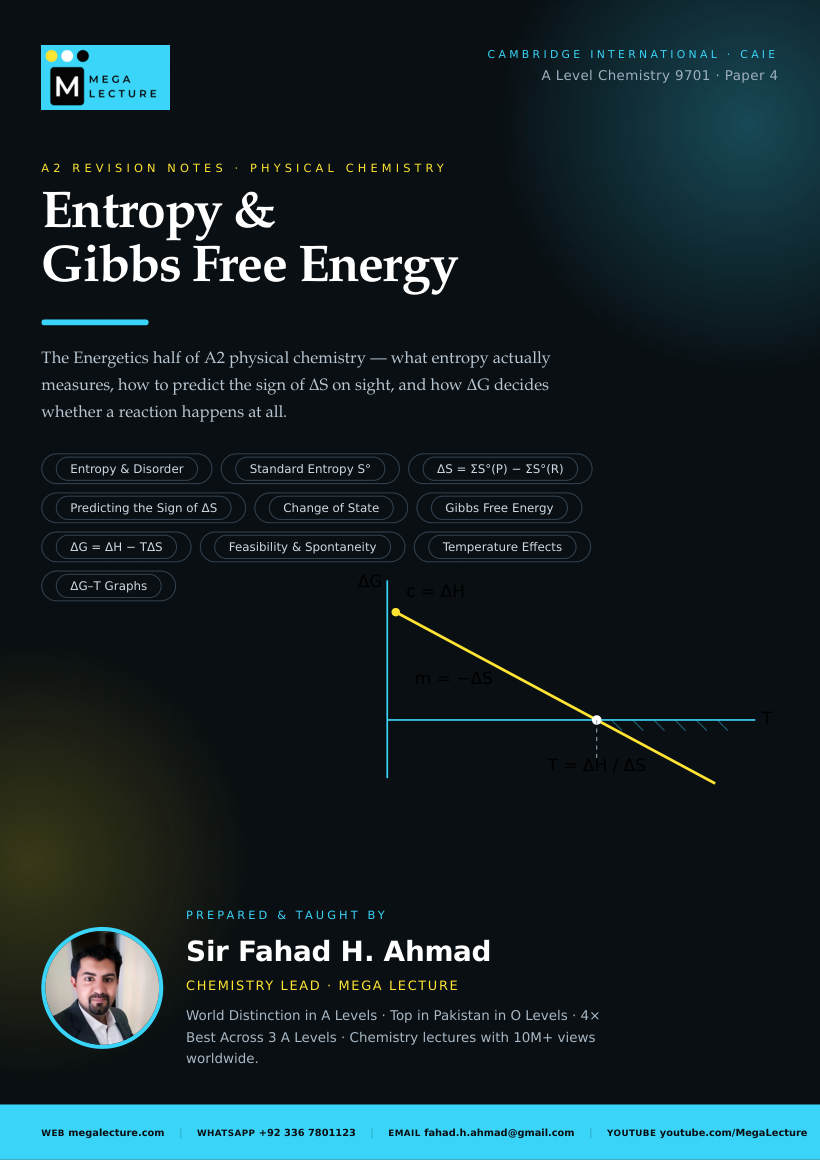
ΔG
T c = ΔH m = −ΔS
T = ΔH / ΔS
Free notes, practice tests and live classes Back to megalecture.com
CAIEALEVELCHEMISTRY·9701
A2 Revision Notes
TOPIC·ENERGETICS
Entropy & Gibbs Free Energy
Entropy and disorder · standard entropies · predicting the sign of ΔS · Gibbs free energy · feasibility and spontaneity · the effect of temperature · ΔG–T graphs. Typed notes with the original handwritten class pages alongside.
Fahad H. Ahmad
CHEMISTRY LEAD · MEGA LECTURE
World Distinction in A Levels · Top in Pakistan in O Levels · 4× Best Across 3 A Levels.
Chemistry lectures with 10M+ views worldwide.
CONTENTS
Entropy — What It Measures
Entropy Change, ΔS
Predicting the Sign of ΔS
Gibbs Free Energy, ΔG
Temperature and Feasibility
Finding the Feasible Temperature
The ΔG–T Graph
Exam Checklist
Entropy — What It Measures
DEFINITION
Entropy (S) is a measure of the disorder of a system — more precisely, of the number of ways the particles and their energy can be arranged.
Units of standard entropy S°: J K−1 mol−1 (note: joules, not kilojoules — this matters later).
1.
2.
3.
4.
5.
6.
7.
8.
CAIE A Level Chemistry · 9701 · Energetics Fahad H. Ahmad · megalecture.com
SIGN OF ΔS WHAT HAS HAPPENED
ΔS = +ve Gain of disorder — more ways to arrange the system
ΔS = −ve Loss of disorder — the system has become more ordered
The tidy-room analogy
A neat, tidy room has very few arrangements that count as "tidy" — the probability of landing in one by chance is close to 0. A messy room has an enormous number of arrangements that all count as "messy" — probability close to 1. Left alone, systems drift towards the state with more ways of existing. That drift is a positive ΔS.
Order to disorder: entropy rises when the number of available arrangements rises.
ΔS = +ve · gain of disorder
ΔS = −ve · loss of disorder w arrangements · probability ≈0 many arrangements · probability
CAIE A Level Chemistry · 9701 · Energetics Fahad H. Ahmad · megalecture.com
Entropy Change, ΔS
Some of the energy released by a reaction does not appear as heat — it goes into spreading the particles out. That share of the energy is linked to the entropy change:
ΔQ = −TΔS → ΔS = −ΔQ / T T in kelvin · ΔS in J K−1 mol−1
W H Y T H I S M AT T E R S
A positive ΔS means a gain of disorder, and that gain is what allows useful work to be produced.
This is the term that will appear in the Gibbs equation in §4.
Reactions with an obvious entropy gain
C8H18(l) → 8 CO2(g) + 9 H2O(g) 1 liquid → 17 molecules of gas · ΔS strongly +ve
H2O(l) → H2O(g) liquid → gas · ΔS +ve
ORIGINAL CL ASS NOTES — ENTROPY DEFINED, TIDY VS MESSY ROOM
CAIE A Level Chemistry · 9701 · Energetics Fahad H. Ahmad · megalecture.com
Calculating ΔS from standard entropies
Most standard entropies S° have already been measured and tabulated at 298 K, 1 atm, 1 mol dm−3, so you rarely calculate one from scratch — you look them up and subtract.
T H E E Q UAT I O N YO U N E E D
ΔS = ΣS°(products) − ΣS°(reactants)
Remember to multiply each S° by the number of moles in the balanced equation.
CONTRASTWITHENTHALPY
ΔHf° of an element in its standard state is zero. The standard entropy of an element is not zero — every substance above 0 K has some disorder. Never drop elements out of an entropy sum.
ΔQ = −TΔS, THE PISTON PICTURE, AND OCTANE COMBUSTION
CAIE A Level Chemistry · 9701 · Energetics Fahad H. Ahmad · megalecture.com
Predicting the Sign of ΔS
Most marks here come from a qualitative judgement, not a calculation. Work through these four checks in order.
1 · Are moles of gas produced or increased?
Gases carry far more entropy than liquids or solids. If the number of moles of gas goes up, ΔS is +ve.
Mg(s) + 2 HCl(aq) → MgCl2(aq) + H2(g) 0 mol gas → 1 mol gas · ΔS = +ve
STANDARD ENTROPIES AND THE ΔS SUMMATION
GAS MOLES AS THE FIRST TEST
CAIE A Level Chemistry · 9701 · Energetics Fahad H. Ahmad · megalecture.com
2 · Is there a change of state?
solid ΔS +ve → liquid ΔS +ve, larger → gas
Solid — regular, fixed lattice; lowest entropy.
Liquid — irregular arrangement, particles free to move past one another.
Gas — very irregular arrangement, high kinetic energy; much the largest jump.
S° rises gently within a phase, then jumps at each change of state — far more on boiling than on melting.
W H Y T H E G E N T L E S LO P E B E T W E E N T H E J U M P S
Within a solid or a liquid, S changes only slightly with temperature — higher kinetic energy makes the arrangement a little more disordered, but the particles are still held together. The step changes at the melting and boiling points are where the big entropy gains happen.
•
•
•
S°
T 0 °C 100 °C ice liquid water steam melting boiling — much bigger jump
CAIE A Level Chemistry · 9701 · Energetics Fahad H. Ahmad · megalecture.com
3 · Has the temperature of a gas risen?
Gases expand as temperature rises, giving a more irregular arrangement. Steam at 1000 °C is considerably more disordered than steam at 101 °C, even though both are the same substance in the same state.
CHANGE OF STATE, PARTICLE PICTURES AND THE S°–T GRAPH
CAIE A Level Chemistry · 9701 · Energetics Fahad H. Ahmad · megalecture.com
4 · If no gases are involved, count the particles
With no gas on either side, look at whether the number of particles increases. More particles → ΔS +ve.
Fewer particles → ΔS −ve.
N E U T R A L I S AT I O N — A N E G AT I V E Δ S
NaOH(aq) + HCl(aq) → NaCl(aq) + H2O(l)
Write it ionically and cancel the spectators (Na+ and Cl−):
OH−(aq) + H+(aq) → H2O(l)
2 particles → 1 particle, and an aqueous ion becomes part of a liquid. ΔS = −ve.
TEMPERATURE AND GAS EXPANSION
CAIE A Level Chemistry · 9701 · Energetics Fahad H. Ahmad · megalecture.com
Gibbs Free Energy, ΔG
DEFINITION
ΔG is the total available energy of a reaction — what is left once you account for both the heat exchanged and the energy tied up in the entropy change.
Where the energy goes
Energy in a reaction splits two ways:
Old bonds broken, new bonds formed — this is the enthalpy term, ΔH. Here the entropy does change.
Kinetic energy increases — the particles simply move faster. Entropy does not change much through this route alone.
ΔG = ( heat produced or absorbed, i.e. ΔH ) + ( work produced by the entropy change, i.e. ΔQ = −TΔS )
T H E E Q UAT I O N — L E A R N I T E X A C T LY
ΔG = ΔH − TΔS
COUNTING PARTICLES WHEN NO GASES ARE INVOLVED
•
•
CAIE A Level Chemistry · 9701 · Energetics Fahad H. Ahmad · megalecture.com
TERM UNITS WATCH OUT FOR
ΔG kJ mol−1 —
ΔH kJ mol−1 —
T K Kelvin, not °C — add 273
ΔS J K−1 mol−1 Divide by 1000 to convert to kJ before use
T H E S I N G L E M O S T C O M M O N M I S TA K E
ΔH is in kilojoules and ΔS is in joules. Mixing them without dividing ΔS by 1000 puts your answer out by a factor of a thousand. Convert first, every time.
WHERE ΔG COMES FROM, AND THE UNITS OF EACH TERM
CAIE A Level Chemistry · 9701 · Energetics Fahad H. Ahmad · megalecture.com
Reading the sign of ΔG
ΔG MEANING VERDICT
ΔG < 0 The system overall produces energy Feasible / spontaneous
ΔG > 0 The system needs energy supplied Not feasible
C A R E F U L W I T H T H E W O R D " E XO T H E R M I C "
It is tempting to read ΔG < 0 as "exothermic", but exothermic describes ΔH, not ΔG. A reaction can be endothermic (ΔH > 0) and still perfectly feasible if TΔS is large enough — melting ice above 0 °C is exactly that. In an exam, describe ΔG < 0 as feasible or spontaneous, and reserve exothermic/ endothermic for ΔH.
F E A S I B L E D O E S N O T M E A N FA S T
ΔG < 0 tells you a reaction can happen, not that it will happen quickly. A large activation energy can leave a thermodynamically feasible reaction imperceptibly slow — diamond turning into graphite is feasible at room temperature and yet nothing visibly happens.
Temperature and Feasibility
Because the entropy term is multiplied by T, changing the temperature can flip a reaction from impossible to spontaneous. Take the two directions of the same change of state.
ΔG < 0 AND ΔG > 0 IN THE ORIGINAL HAND
CAIE A Level Chemistry · 9701 · Energetics Fahad H. Ahmad · megalecture.com
BOILING—H2O(L)→H2O(G)
ΔS = +ve (liquid → gas) and ΔH = +ve (energy needed to break the hydrogen bonding).
ΔG = ΔH − TΔS = (+ve) − T(+ve)
The second term is negative and grows with T. At a high enough temperature it outweighs ΔH and
ΔG becomes negative.
TEMPERATURE OUTCOME
−10 °C Not spontaneous
50 °C Not spontaneous
150 °C Spontaneous
Spontaneous at T > 373 K
FREEZING—H2O(L)→H2O(S)
ΔS = −ve (liquid → solid) and ΔH = −ve (energy released as hydrogen bonds form).
ΔG = ΔH − TΔS = (−ve) − T(−ve) = (−ve) + (+ve)
Now the entropy term is positive and grows with T, working against feasibility. So freezing needs a low temperature for ΔG < 0 — which is exactly what you would expect.
CAIE A Level Chemistry · 9701 · Energetics Fahad H. Ahmad · megalecture.com
BOILING AND FREEZING ANALYSED SIDE BY SIDE
CAIE A Level Chemistry · 9701 · Energetics Fahad H. Ahmad · megalecture.com
The four cases — worth memorising
ΔH ΔS ΔG FEASIBLE WHEN
+ve +ve ΔG < 0 at higher T Heat it enough
−ve −ve ΔG < 0 at lower T Cool it enough
−ve +ve ΔG < 0 always Every temperature
+ve −ve ΔG > 0 always Never feasible
A standard exam example
CaCO3(s) → CaO(s) + CO2(g) ΔS = +ve (gas produced) · ΔH = +ve (endothermic)
This is the first row of the table: thermal decomposition of limestone is not feasible at room temperature but becomes feasible in a lime kiln at high temperature.
THE FOUR-CASE TABLE, EXACTLY AS WRITTEN IN CL ASS
THE +VE/−VE CASE AND CALCIUM CARBONATE
CAIE A Level Chemistry · 9701 · Energetics Fahad H. Ahmad · megalecture.com
Finding the Feasible Temperature
A very common question: at what temperature does this reaction become feasible? Set ΔG < 0 and rearrange.
I N E Q UA L I T Y T R A P
If you divide or multiply an inequality by a negative value, the sign flips — < becomes >. So when
ΔS is negative, step 4 gives T < ΔH / ΔS instead. Check the sign of ΔS before you write the final answer.
Start from the feasibility condition: ΔG < 0
Substitute the Gibbs equation: ΔH − TΔS < 0
Move the entropy term across: ΔH < TΔS
Divide by ΔS: T > ΔH / ΔS
REARRANGING ΔG < 0 TO FIND THE TEMPERATURE
CAIE A Level Chemistry · 9701 · Energetics Fahad H. Ahmad · megalecture.com
W O R K E D E X A M P L E — AT W H AT T E M P E R AT U R E D O E S WAT E R B O I L ?
H2O(l) → H2O(g) ΔH = 40.8 kJ mol−1 ΔS = 109 J mol−1 K−1
Which is essentially the boiling point of water, 373 K — a good check that the method is sound. Above this temperature the entropy term wins and vaporisation is spontaneous; below it, condensation is.
The ΔG–T Graph
Rearranged into the form of a straight line, the Gibbs equation becomes one of the neatest graph questions on the paper.
ΔG = ΔH − TΔS → ΔG = (−ΔS) × T + ΔH
ΔG < 0 → ΔH − TΔS < 0
Convert ΔS to kJ: 40.8 − T(109 / 1000) < 0
Rearrange: T > (1000 × 40.8) / 109
T > 374 K (about 101 °C)
THE FULL WORKED CALCUL ATION
CAIE A Level Chemistry · 9701 · Energetics Fahad H. Ahmad · megalecture.com y=m×x+c
GRAPH FEATURE CORRESPONDS TO y-axis ΔG x-axis T (in kelvin)
Gradient, m −ΔS — so a downward slope means ΔS is positive y-intercept, c ΔH x-intercept T = ΔH / ΔS — the temperature at which the reaction turns feasible
For ΔH and ΔS both positive: the line starts at ΔH, slopes down at −ΔS, and crosses zero at T = ΔH/ΔS.
HOWTHEGRAPHISEXAMINED
You are usually given the plotted line and asked to extract ΔH and ΔS. Read the intercept for ΔH, take the gradient and change its sign for ΔS (remembering the answer comes out in kJ K−1 mol−1, so multiply by 1000 for J K−1 mol−1), and read the x-intercept for the temperature at which the reaction becomes feasible.
ΔG
T c = ΔH
T = ΔH / ΔS gradient m = −ΔS
ΔG > 0 · not feasible ΔG < 0 · feasible
CAIE A Level Chemistry · 9701 · Energetics Fahad H. Ahmad · megalecture.com
Exam Checklist
Define entropy as a measure of disorder — of the number of ways particles and energy can be arranged.
S° is in J K−1 mol−1; ΔH and ΔG are in kJ mol−1. Divide ΔS by 1000 before using the Gibbs equation.
Temperature is always in kelvin.
ΔS = ΣS°(products) − ΣS°(reactants), multiplied through by the moles in the balanced equation.
The entropy of an element is not zero, unlike its ΔHf°.
To predict the sign of ΔS: gas moles first, then change of state, then temperature, then particle count.
ΔG = ΔH − TΔS. ΔG < 0 → feasible; ΔG > 0 → not feasible.
Say feasible or spontaneous for ΔG, not "exothermic" — that word belongs to ΔH.
Feasible ≠ fast. A high activation energy can still make a spontaneous reaction unobservably slow.
T > ΔH/ΔS gives the feasible temperature — but the inequality flips if ΔS is negative.
On a ΔG–T graph: intercept = ΔH, gradient = −ΔS, x-intercept = ΔH/ΔS.
ΔG = −ΔS·T + ΔH MAPPED ONTO Y = MX + C
•
•
•
•
•
•
•
•
•
•
•
CAIE A Level Chemistry · 9701 · Energetics Fahad H. Ahmad · megalecture.com
Fahad H. Ahmad
C H E M I S T RY L E A D · M E G A L E C T U R E
1-to-1 or small group, online.
WEB megalecture.com
EMAIL fahad.h.ahmad@gmail.com
YOUTUBE youtube.com/MegaLecture
CAIE A Level Chemistry · 9701 · Energetics Fahad H. Ahmad · megalecture.com
