
O Level · Pakistan Studies 2059 · Topic Notes (chronological)
Pakistan’s foreign relations 1947-99
Opens inside this page. Prefer your own PDF app? Open the PDF.
New: small group classes for O Level Pakistan Studies are opening, at a lower fee than one-to-one. Join the waiting list
Check yourself
5 quick questions on O Level Pakistan Studies
Tap an answer to see if you are right, and why. Free, no sign-up.
Start the free test4 of 5 students found these notes useful
Was this note useful?
Full text of Pakistan’s foreign relations 1947-99
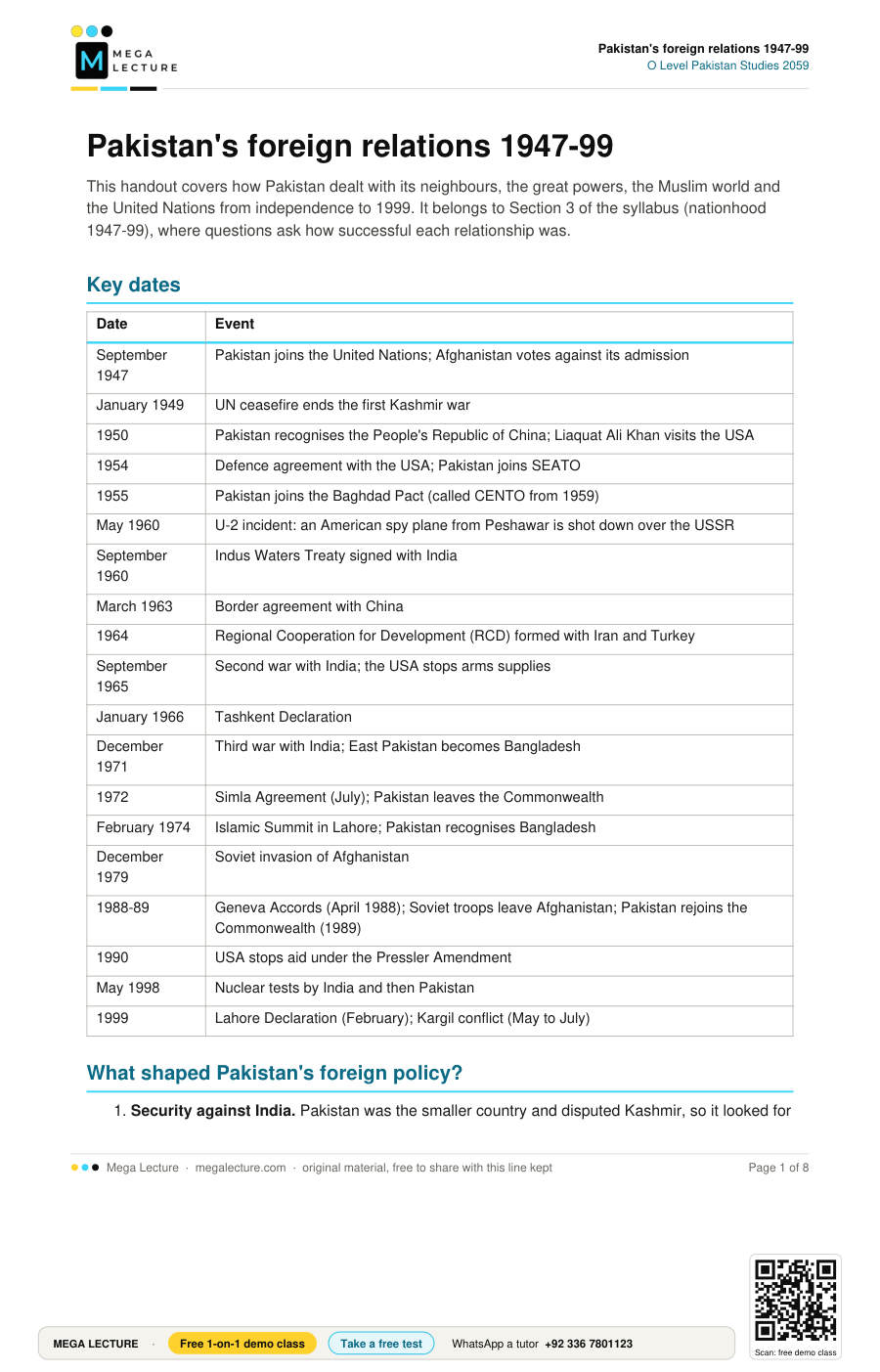
This handout covers how Pakistan dealt with its neighbours, the great powers, the Muslim world and the United Nations from independence to 1999. It belongs to Section 3 of the syllabus (nationhood 1947-99), where questions ask how successful each relationship was.
Key dates
| Date | Event |
|---|---|
| September 1947 | Pakistan joins the United Nations; Afghanistan votes against its admission |
| January 1949 | UN ceasefire ends the first Kashmir war |
| 1950 | Pakistan recognises the People's Republic of China; Liaquat Ali Khan visits the USA |
| 1954 | Defence agreement with the USA; Pakistan joins SEATO |
| 1955 | Pakistan joins the Baghdad Pact (called CENTO from 1959) |
| May 1960 | U-2 incident: an American spy plane from Peshawar is shot down over the USSR |
| September 1960 | Indus Waters Treaty signed with India |
| March 1963 | Border agreement with China |
| 1964 | Regional Cooperation for Development (RCD) formed with Iran and Turkey |
| September 1965 | Second war with India; the USA stops arms supplies |
| January 1966 | Tashkent Declaration |
| December 1971 | Third war with India; East Pakistan becomes Bangladesh |
| 1972 | Simla Agreement (July); Pakistan leaves the Commonwealth |
| February 1974 | Islamic Summit in Lahore; Pakistan recognises Bangladesh |
| December 1979 | Soviet invasion of Afghanistan |
| 1988-89 | Geneva Accords (April 1988); Soviet troops leave Afghanistan; Pakistan rejoins the Commonwealth (1989) |
| 1990 | USA stops aid under the Pressler Amendment |
| May 1998 | Nuclear tests by India and then Pakistan |
| 1999 | Lahore Declaration (February); Kargil conflict (May to July) |
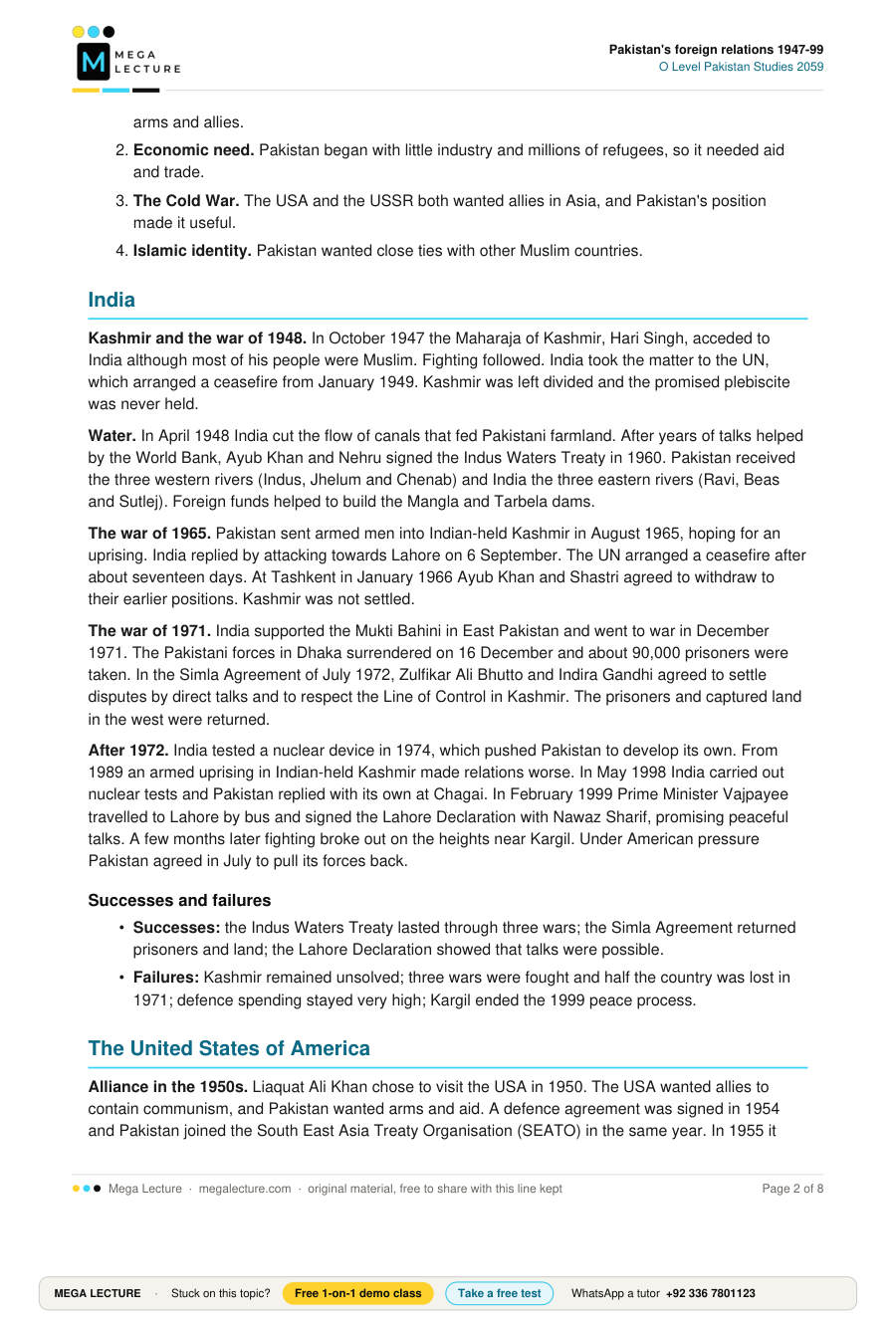
What shaped Pakistan's foreign policy?
- Security against India. Pakistan was the smaller country and disputed Kashmir, so it looked for arms and allies.
- Economic need. Pakistan began with little industry and millions of refugees, so it needed aid and trade.
- The Cold War. The USA and the USSR both wanted allies in Asia, and Pakistan's position made it useful.
- Islamic identity. Pakistan wanted close ties with other Muslim countries.
India
Kashmir and the war of 1948. In October 1947 the Maharaja of Kashmir, Hari Singh, acceded to India although most of his people were Muslim. Fighting followed. India took the matter to the UN, which arranged a ceasefire from January 1949. Kashmir was left divided and the promised plebiscite was never held.
Water. In April 1948 India cut the flow of canals that fed Pakistani farmland. After years of talks helped by the World Bank, Ayub Khan and Nehru signed the Indus Waters Treaty in 1960. Pakistan received the three western rivers (Indus, Jhelum and Chenab) and India the three eastern rivers (Ravi, Beas and Sutlej). Foreign funds helped to build the Mangla and Tarbela dams.
The war of 1965. Pakistan sent armed men into Indian-held Kashmir in August 1965, hoping for an uprising. India replied by attacking towards Lahore on 6 September. The UN arranged a ceasefire after about seventeen days. At Tashkent in January 1966 Ayub Khan and Shastri agreed to withdraw to their earlier positions. Kashmir was not settled.
The war of 1971. India supported the Mukti Bahini in East Pakistan and went to war in December 1971. The Pakistani forces in Dhaka surrendered on 16 December and about 90,000 prisoners were taken. In the Simla Agreement of July 1972, Zulfikar Ali Bhutto and Indira Gandhi agreed to settle disputes by direct talks and to respect the Line of Control in Kashmir. The prisoners and captured land in the west were returned.
After 1972. India tested a nuclear device in 1974, which pushed Pakistan to develop its own. From 1989 an armed uprising in Indian-held Kashmir made relations worse. In May 1998 India carried out nuclear tests and Pakistan replied with its own at Chagai. In February 1999 Prime Minister Vajpayee travelled to Lahore by bus and signed the Lahore Declaration with Nawaz Sharif, promising peaceful talks. A few months later fighting broke out on the heights near Kargil. Under American pressure Pakistan agreed in July to pull its forces back.
Successes and failures
- Successes: the Indus Waters Treaty lasted through three wars; the Simla Agreement returned prisoners and land; the Lahore Declaration showed that talks were possible.
- Failures: Kashmir remained unsolved; three wars were fought and half the country was lost in 1971; defence spending stayed very high; Kargil ended the 1999 peace process.
The United States of America
Alliance in the 1950s. Liaquat Ali Khan chose to visit the USA in 1950. The USA wanted allies to contain communism, and Pakistan wanted arms and aid. A defence agreement was signed in 1954 and Pakistan joined the South East Asia Treaty Organisation (SEATO) in the same year. In 1955 it joined the Baghdad Pact with Britain, Turkey, Iran and Iraq, renamed the Central Treaty Organisation (CENTO) in 1959. Large amounts of military and economic aid followed.
Strains. In May 1960 a U-2 spy plane that had taken off from Peshawar was shot down over the USSR, and the Soviet leader Khrushchev threatened Pakistan. During the 1965 war the USA stopped arms supplies to both sides, which hurt Pakistan more because its weapons were American. SEATO and CENTO gave no help in 1965 or 1971, since they were aimed at communism and not at India. Pakistan announced it was leaving SEATO in 1972 and left CENTO in 1979.
Ups and downs in the 1970s. In 1971 Pakistan helped to arrange Henry Kissinger's secret visit to China. However, the USA opposed Pakistan's nuclear programme and cut aid in the late 1970s.
The Afghan war. The Soviet invasion of Afghanistan in December 1979 made Pakistan a front-line state. In 1981 President Reagan agreed a package worth about 3.2 billion dollars, including F-16 aircraft.
After the war. Once Soviet troops had left, the USA needed Pakistan less. The Pressler Amendment of 1985 required the President to confirm each year that Pakistan had no nuclear weapon. In 1990 he did not do so, and aid was stopped. F-16s already paid for were not delivered. More sanctions followed the 1998 nuclear tests.
Successes and failures
- Successes: modern weapons and training for the armed forces; large economic aid in the 1950s, 1960s and 1980s; American support against the Soviet presence in Afghanistan.
- Failures: no help against India in 1965 or 1971; arms embargoes and the Pressler cut-off; the alliance angered the USSR; aid depended on American needs.
The USSR and Russia
Relations began badly. Liaquat Ali Khan received an invitation to Moscow in 1949 but went to Washington instead. When Pakistan joined the American pacts, the USSR backed India over Kashmir, using its veto in the Security Council, and supported Afghanistan's Pakhtunistan claim. The U-2 incident of 1960 made matters worse.
There was some improvement in the 1960s. The USSR agreed in 1961 to help search for oil in Pakistan, Ayub Khan visited Moscow in 1965, and the Soviet Union hosted the Tashkent talks in 1966. In 1971, however, the USSR signed a friendship treaty with India and supported it during the war. Bhutto visited Moscow in 1972, and the USSR helped to build the Pakistan Steel Mills near Karachi.
The Soviet invasion of Afghanistan brought the lowest point, because Pakistan supported the mujahideen. Soviet troops left under the Geneva Accords of 1988. After the USSR broke up in 1991, relations with Russia were calm but limited, since Russia kept its close ties with India.
Successes and failures
- Successes: oil exploration and the steel mill; Soviet mediation at Tashkent; the Soviet withdrawal from Afghanistan.
- Failures: Soviet vetoes on Kashmir; the U-2 threat; Soviet support for India in 1971; a decade of hostility during the Afghan war.
China
Pakistan recognised the People's Republic of China in 1950, one of the first Muslim countries to do so. Relations became close after the war between China and India in 1962, since both countries now had the same rival.
- Border agreement, 1963. The two countries settled their border in the northern areas peacefully. Trade and air service agreements followed, and PIA began flights to China.
- Support in war. In 1965 China backed Pakistan in public and warned India, and it supplied arms when American supplies stopped. In 1971 it gave diplomatic support, but it did not intervene.
- Karakoram Highway. Built jointly through the Khunjerab Pass and completed in 1978, it gave a road link for trade between the two countries.
- Economic and military help. China helped to set up the Heavy Mechanical Complex at Taxila, supplied tanks and aircraft, and later assisted with nuclear power.
Successes and failures
- Successes: a settled border; a steady supply of arms without embargoes; support on Kashmir at the UN; the highway and industrial projects. This was Pakistan's most consistent friendship.
- Failures: China did not fight for Pakistan in 1965 or 1971; trade stayed small compared with trade with the West; the friendship worried the USA in the 1960s.
Britain and the Commonwealth
Pakistan became a Dominion in the Commonwealth in 1947. British officers stayed on to help build the army and the civil service. Pakistan became a republic in 1956 but remained a member. Britain was a partner in the Baghdad Pact, gave aid, bought Pakistani exports and became home to a large Pakistani community.
The Commonwealth did not help Pakistan over Kashmir, although the British Prime Minister helped to end the Rann of Kutch fighting in 1965. When Britain and other members recognised Bangladesh, Bhutto took Pakistan out of the Commonwealth in 1972. Trade and aid continued. Pakistan rejoined in 1989 under Benazir Bhutto. After the military takeover of October 1999 its membership was suspended.
Successes and failures
- Successes: early help with officers and administration; aid, trade and education links; rejoining in 1989.
- Failures: no support on Kashmir; the break of 1972 to 1989; suspension in 1999.
Afghanistan
Durand Line and Pakhtunistan. The Durand Line of 1893 was the border agreed between British India and Afghanistan. After 1947 Afghanistan refused to accept it and claimed that the Pakhtuns of Pakistan should have their own state, "Pakhtunistan". For this reason Afghanistan was the only country to vote against Pakistan joining the UN. Diplomatic relations were cut from 1961 to 1963 until the Shah of Iran helped to restore them. Afghanistan stayed neutral in the wars of 1965 and 1971. Afghanistan has no coast, so its trade passed through Karachi.
Soviet invasion and refugees. A communist government took power in Kabul in 1978 and Soviet troops invaded in December 1979. More than three million refugees crossed into Pakistan. Pakistan sheltered them and supported the mujahideen. The war brought foreign aid but also weapons and drugs. The Geneva Accords of April 1988 led to the Soviet withdrawal, completed in 1989.
After 1989. Civil war continued among Afghan groups. The Taliban took Kabul in 1996 and Pakistan recognised their government in 1997, one of only three countries to do so. Many refugees stayed in Pakistan.
Successes and failures
- Successes: Afghan neutrality in 1965 and 1971; transit trade; the Soviet withdrawal; Pakistan's help for refugees won respect abroad.
- Failures: the border was never accepted by Kabul; relations were broken in 1961; the refugee burden and the spread of guns and drugs; no stable, friendly government emerged by 1999.
Iran
Iran was the first country to recognise Pakistan, and the Shah was the first head of state to visit, in 1950. The two countries were partners in the Baghdad Pact and CENTO, and in 1964 they formed the RCD with Turkey to promote trade, transport and joint industries. Iran gave Pakistan diplomatic and material support in the wars of 1965 and 1971.
After the Islamic Revolution of 1979 Pakistan quickly recognised the new government. Relations stayed correct but were less warm, because Iran was hostile to the USA while Pakistan was its ally. The RCD was revived as the Economic Cooperation Organisation (ECO) in 1985. In the 1990s they backed different sides in Afghanistan.
Successes and failures
- Successes: early recognition; help in 1965 and 1971; RCD and ECO; a peaceful shared border.
- Failures: RCD achieved little trade; cooler relations after 1979; disagreement over the Taliban.
Bangladesh
Bangladesh was born out of the war of 1971, so relations began with bitterness. Pakistan at first refused to recognise the new state. Bhutto gave recognition in February 1974, just before the Lahore summit, which Sheikh Mujib-ur-Rahman then attended. Bhutto visited Dhaka later that year, but disputes remained over the division of assets and over the Urdu-speaking Biharis stranded in Bangladesh who wished to move to Pakistan.
Relations improved after the change of government in Dhaka in 1975. Ambassadors were exchanged in 1976 and trade grew. Both countries were founding members of the South Asian Association for Regional Cooperation (SAARC) in 1985, and Pakistan sent relief after floods and cyclones in Bangladesh.
Successes and failures
- Successes: recognition in 1974; diplomatic and trade links from 1976; cooperation in SAARC and the OIC.
- Failures: the memory of 1971; the assets and Bihari questions were not fully settled; trade stayed modest.
The Muslim world
From the start Pakistan supported the Palestinians and spoke at the UN for the independence of Muslim countries such as Indonesia, Libya, Tunisia, Morocco and Algeria.
- OIC. Pakistan was a founding member of the Organisation of the Islamic Conference (OIC), set up in 1969 after an arson attack on the Al-Aqsa Mosque in Jerusalem.
- Lahore summit, 1974. Bhutto hosted the second Islamic Summit in Lahore in February 1974. Leaders of most Muslim states attended. It raised Pakistan's standing after the defeat of 1971 and supported the Palestinian cause.
- Arab states and the Gulf. Pakistan backed the Arab side in the wars of 1967 and 1973. After the oil price rise of 1973, Saudi Arabia and other Gulf states gave loans and aid, and millions of Pakistanis found work there and sent money home.
- RCD and ECO. RCD (1964) linked Pakistan, Iran and Turkey. It became ECO in 1985, and in 1992 Afghanistan and six Central Asian republics joined, making ten members.
Successes and failures
- Successes: leadership shown at Lahore in 1974; aid, oil and jobs from the Gulf; wide support for Pakistan's position on Kashmir in the OIC.
- Failures: the OIC could not settle disputes such as the Iran-Iraq war or Kashmir; RCD and ECO produced limited trade; Muslim states were often divided among themselves.
The United Nations
Pakistan joined the UN on 30 September 1947. The UN arranged the Kashmir ceasefire of 1949, placed observers along the ceasefire line and passed resolutions calling for a plebiscite, but it could not make India hold one. The Security Council also arranged the ceasefire of 1965. In 1971 Soviet vetoes blocked action, and the UN did not prevent the loss of East Pakistan.
Pakistan gained in other ways. The World Bank, a UN agency, brought about the Indus Waters Treaty and helped to fund the dams. UN agencies supported health, education and the Afghan refugees, and the Geneva Accords were negotiated under the UN. Pakistan also contributed: Sir Zafarullah Khan served as President of the General Assembly and as a judge of the International Court of Justice, Pakistan sat on the Security Council several times, and its soldiers served as peacekeepers, for example in Somalia and Bosnia in the 1990s.
Successes and failures
- Successes: ceasefires in 1949 and 1965; the Indus Waters Treaty; aid from UN agencies; a respected role in peacekeeping.
- Failures: the Kashmir plebiscite was never held; no help in 1971; UN resolutions could not be enforced.
How successful was Pakistan's foreign policy?
Successful. Pakistan survived as an independent state beside a much larger rival. It gained arms and aid from the USA, a dependable friend in China, a fair share of the Indus waters, money and jobs from the Gulf, and a respected voice in the OIC and the UN. It helped to force a Soviet withdrawal from Afghanistan and by 1998 it had a nuclear deterrent.
Unsuccessful. The main aim, a settlement in Kashmir, was not achieved. Allies did not prevent defeat in 1971. Heavy reliance on the USA brought embargoes whenever American interests changed. The Afghan war left refugees, weapons and drugs. Defence spending took money away from schools and health.
Judgement. Relations with China and with the Muslim world were the most successful because they were steady and cost Pakistan little. Relations with India were the least successful, and since fear of India drove most other choices, this failure limited what the rest of the policy could achieve.
Key terms and people
- SEATO and CENTO: American-backed alliances against communism that Pakistan joined in 1954 and 1955.
- Plebiscite: a vote by the people of Kashmir on their future, called for by the UN.
- Line of Control: the line dividing Kashmir, named in the Simla Agreement of 1972.
- Pressler Amendment: American law linking aid to proof that Pakistan had no nuclear weapon.
- Pakhtunistan: the Afghan-backed demand for a separate Pakhtun state.
- People: Liaquat Ali Khan, Ayub Khan, Zulfikar Ali Bhutto, Zia-ul-Haq, Benazir Bhutto, Nawaz Sharif, Sir Zafarullah Khan.
Exam practice
- Describe the U-2 incident of 1960. [4]
- Why did Pakistan join SEATO and CENTO in the 1950s? [7]
- "Pakistan's relationship with China was more successful than its relationship with any other country between 1947 and 1999." How far do you agree? Explain your answer. [14]
Question 1 (four points). An American U-2 spy plane took off from the base near Peshawar in May 1960. It was shot down over the USSR and its pilot, Gary Powers, was captured. The Soviet leader Khrushchev was angry and threatened Peshawar. Relations with the USSR were damaged.
Question 2 (three explained reasons). (1) Security: Pakistan feared India after the Kashmir war and wanted modern weapons and allies, which the pacts seemed to offer. (2) Aid: the economy was weak, and membership brought American military and economic assistance. (3) The Cold War and Muslim links: the USA was seeking allies against communism, and the Baghdad Pact also tied Pakistan to Turkey, Iran and Iraq, which fitted its wish for closer ties with Muslim states.
Question 3 (two sides and a judgement). Agree: the border agreement of 1963, support and arms in 1965, diplomatic backing in 1971 and on Kashmir, the Karakoram Highway, industrial help at Taxila, and no embargoes or breaks. Disagree: China did not intervene in the wars and trade was small; other relationships also brought large gains, such as American aid and arms in the 1950s and 1980s, Gulf aid and jobs, Iranian support, and the Indus Waters Treaty through the World Bank. Judgement: explain which mattered most, for example that American aid was larger but unreliable, while Chinese friendship was steady, so China was the most successful relationship overall.
