
O Level · Pakistan Studies 2059 · Topic Notes (chronological)
Benazir Bhutto and Nawaz Sharif, 1988-99
Opens inside this page. Prefer your own PDF app? Open the PDF.
New: small group classes for O Level Pakistan Studies are opening, at a lower fee than one-to-one. Join the waiting list
Check yourself
5 quick questions on Nationhood: 1971 to 1999 and Pakistan in world affairs
Tap an answer to see if you are right, and why. Free, no sign-up.
Start the free test4 of 5 students found these notes useful
Was this note useful?
Full text of Benazir Bhutto and Nawaz Sharif, 1988-99
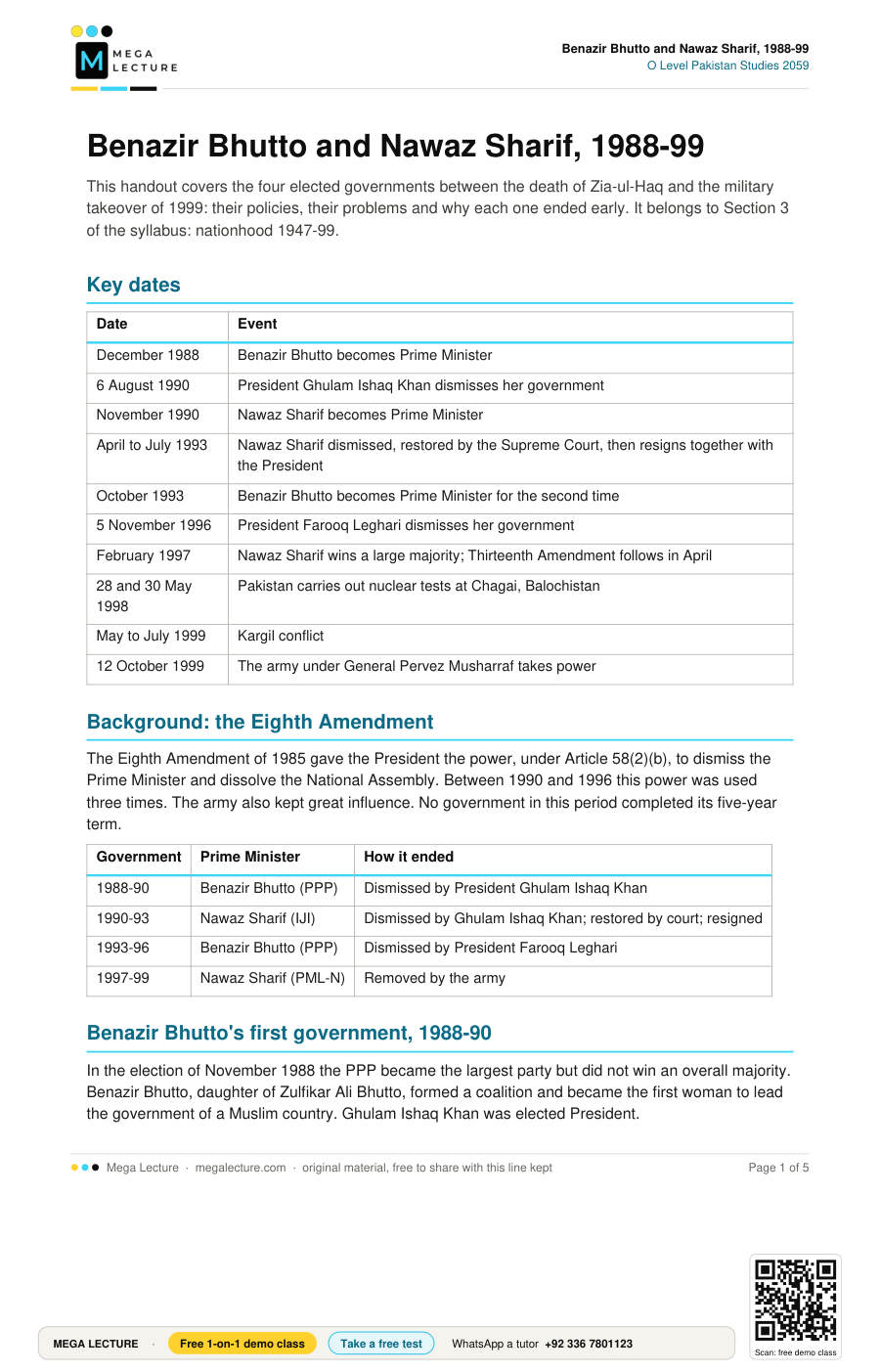
This handout covers the four elected governments between the death of Zia-ul-Haq and the military takeover of 1999: their policies, their problems and why each one ended early. It belongs to Section 3 of the syllabus: nationhood 1947-99.
Key dates
| Date | Event |
|---|---|
| December 1988 | Benazir Bhutto becomes Prime Minister |
| 6 August 1990 | President Ghulam Ishaq Khan dismisses her government |
| November 1990 | Nawaz Sharif becomes Prime Minister |
| April to July 1993 | Nawaz Sharif dismissed, restored by the Supreme Court, then resigns together with the President |
| October 1993 | Benazir Bhutto becomes Prime Minister for the second time |
| 5 November 1996 | President Farooq Leghari dismisses her government |
| February 1997 | Nawaz Sharif wins a large majority; Thirteenth Amendment follows in April |
| 28 and 30 May 1998 | Pakistan carries out nuclear tests at Chagai, Balochistan |
| May to July 1999 | Kargil conflict |
| 12 October 1999 | The army under General Pervez Musharraf takes power |
Background: the Eighth Amendment
The Eighth Amendment of 1985 gave the President the power, under Article 58(2)(b), to dismiss the Prime Minister and dissolve the National Assembly. Between 1990 and 1996 this power was used three times. The army also kept great influence. No government in this period completed its five-year term.
| Government | Prime Minister | How it ended |
|---|---|---|
| 1988-90 | Benazir Bhutto (PPP) | Dismissed by President Ghulam Ishaq Khan |
| 1990-93 | Nawaz Sharif (IJI) | Dismissed by Ghulam Ishaq Khan; restored by court; resigned |
| 1993-96 | Benazir Bhutto (PPP) | Dismissed by President Farooq Leghari |
| 1997-99 | Nawaz Sharif (PML-N) | Removed by the army |
Benazir Bhutto's first government, 1988-90
In the election of November 1988 the PPP became the largest party but did not win an overall majority. Benazir Bhutto, daughter of Zulfikar Ali Bhutto, formed a coalition and became the first woman to lead the government of a Muslim country. Ghulam Ishaq Khan was elected President.
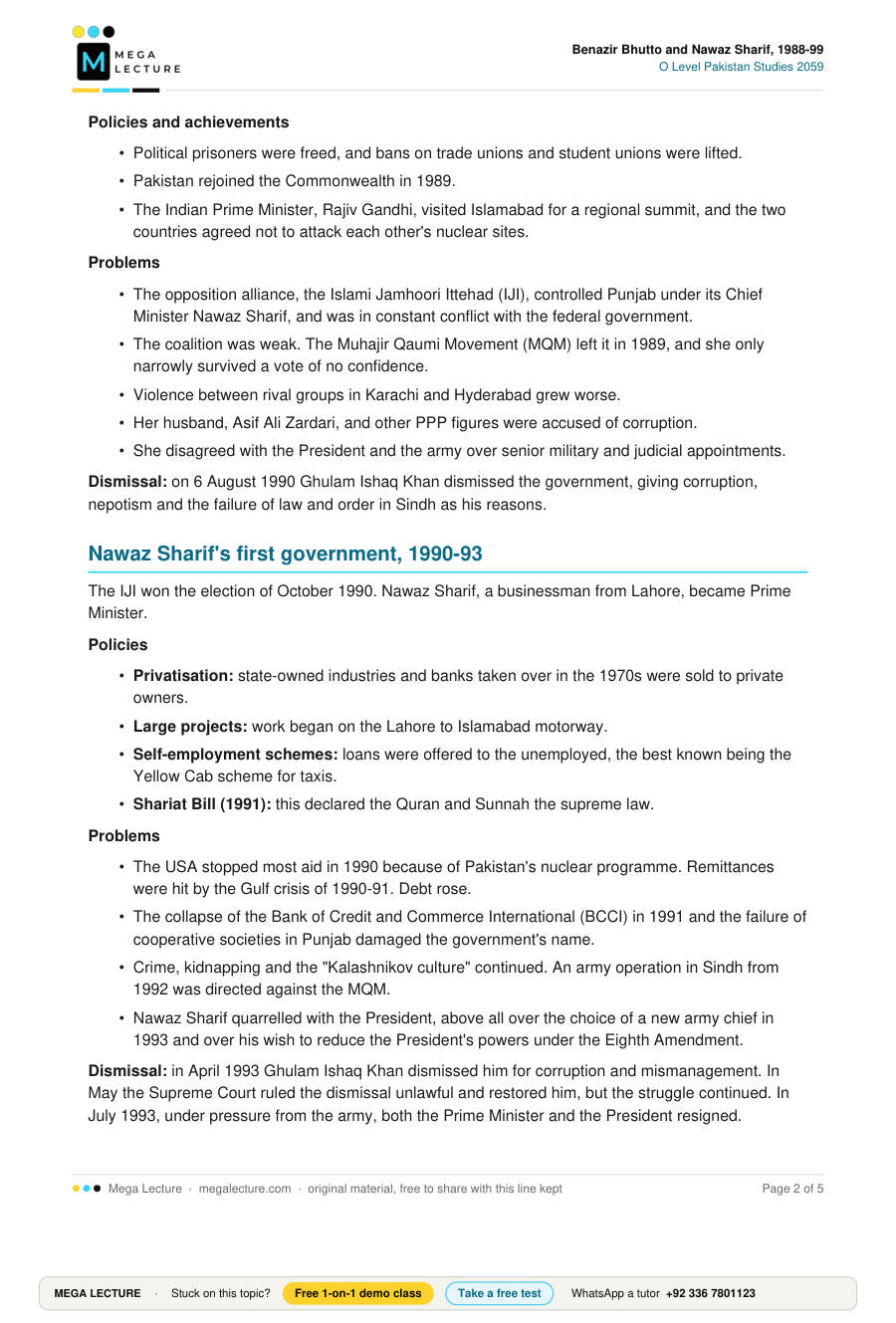
Policies and achievements
- Political prisoners were freed, and bans on trade unions and student unions were lifted.
- Pakistan rejoined the Commonwealth in 1989.
- The Indian Prime Minister, Rajiv Gandhi, visited Islamabad for a regional summit, and the two countries agreed not to attack each other's nuclear sites.
Problems
- The opposition alliance, the Islami Jamhoori Ittehad (IJI), controlled Punjab under its Chief Minister Nawaz Sharif, and was in constant conflict with the federal government.
- The coalition was weak. The Muhajir Qaumi Movement (MQM) left it in 1989, and she only narrowly survived a vote of no confidence.
- Violence between rival groups in Karachi and Hyderabad grew worse.
- Her husband, Asif Ali Zardari, and other PPP figures were accused of corruption.
- She disagreed with the President and the army over senior military and judicial appointments.
Dismissal: on 6 August 1990 Ghulam Ishaq Khan dismissed the government, giving corruption, nepotism and the failure of law and order in Sindh as his reasons.
Nawaz Sharif's first government, 1990-93
The IJI won the election of October 1990. Nawaz Sharif, a businessman from Lahore, became Prime Minister.
Policies
- Privatisation: state-owned industries and banks taken over in the 1970s were sold to private owners.
- Large projects: work began on the Lahore to Islamabad motorway.
- Self-employment schemes: loans were offered to the unemployed, the best known being the Yellow Cab scheme for taxis.
- Shariat Bill (1991): this declared the Quran and Sunnah the supreme law.
Problems
- The USA stopped most aid in 1990 because of Pakistan's nuclear programme. Remittances were hit by the Gulf crisis of 1990-91. Debt rose.
- The collapse of the Bank of Credit and Commerce International (BCCI) in 1991 and the failure of cooperative societies in Punjab damaged the government's name.
- Crime, kidnapping and the "Kalashnikov culture" continued. An army operation in Sindh from 1992 was directed against the MQM.
- Nawaz Sharif quarrelled with the President, above all over the choice of a new army chief in 1993 and over his wish to reduce the President's powers under the Eighth Amendment.
Dismissal: in April 1993 Ghulam Ishaq Khan dismissed him for corruption and mismanagement. In May the Supreme Court ruled the dismissal unlawful and restored him, but the struggle continued. In July 1993, under pressure from the army, both the Prime Minister and the President resigned.
Benazir Bhutto's second government, 1993-96
The PPP won most seats in October 1993 and Benazir Bhutto returned as Prime Minister. A PPP member, Farooq Leghari, was elected President.
Policies and achievements
- Private companies were invited to build power stations to reduce electricity shortages.
Problems
- The economy was under strain: debt was heavy, the rupee was devalued, prices rose and new taxes demanded by the International Monetary Fund were unpopular.
- Karachi suffered years of killings. Police action was criticised for deaths in custody.
- Her brother, Mir Murtaza Bhutto, who opposed her leadership, was shot dead by police in Karachi in September 1996.
- Corruption charges increased, especially against Asif Ali Zardari, who had been made a minister.
- She clashed with the judiciary over the appointment of judges, and her relations with Leghari broke down.
Dismissal: on 5 November 1996 Leghari dismissed the government for corruption, economic mismanagement and unlawful killings in Karachi. The Supreme Court upheld his decision.
Nawaz Sharif's second government, 1997-99
In February 1997 Nawaz Sharif's Pakistan Muslim League (N) won more than two-thirds of the National Assembly seats.
- Thirteenth Amendment (1997): Parliament removed the President's power to dismiss governments under Article 58(2)(b).
- Conflict with the courts and the President: a dispute with the Chief Justice ended with government supporters storming the Supreme Court building in late 1997. President Leghari resigned and Rafiq Tarar, a supporter of the Prime Minister, replaced him.
- Conflict with the army: in 1998 the army chief, General Jehangir Karamat, resigned after a disagreement with the government. General Pervez Musharraf was appointed in his place.
- The economy: the motorway was opened, but debt remained very high.
The nuclear tests, 1998
India carried out nuclear tests in May 1998. Pakistan tested its own devices in the Chagai hills of Balochistan on 28 and 30 May. The tests were very popular in Pakistan. The USA, Japan and others imposed economic sanctions. The government froze foreign currency bank accounts, which damaged confidence.
Lahore and Kargil, 1999
In February 1999 the Indian Prime Minister, Atal Bihari Vajpayee, travelled by bus to Lahore and signed the Lahore Declaration. A few months later fighters crossed the Line of Control and occupied heights near Kargil overlooking an important Indian road. India used its army and air force to retake them and world opinion blamed Pakistan. In July Nawaz Sharif met President Clinton in Washington and agreed to a withdrawal. The Prime Minister and the army command each blamed the other.
The military takeover, October 1999
On 12 October 1999 Nawaz Sharif announced the dismissal of General Musharraf while the general was on a flight home from Sri Lanka, and named the head of intelligence as the new army chief. The aircraft was at first refused permission to land at Karachi. Army units quickly took control. Nawaz Sharif was arrested and General Musharraf took charge of the country with the title of Chief Executive.
How successful were the governments of 1988-99?
Successes: elections were held regularly and power changed hands by the vote; the press was freer than under military rule; privatisation and the motorway modernised parts of the economy; Pakistan became a nuclear power.
Failures: no government completed its term; the two main parties used their time in office to weaken each other; corruption charges were made against every government; foreign debt grew to a dangerous level; violence in Karachi and sectarian attacks continued; sanctions after 1998 and the Kargil conflict left Pakistan isolated.
Judgement: there was real progress in some areas, but as a period of democratic government the decade was largely unsuccessful. The presidential power of dismissal and the army's influence made stable government difficult, and the politicians added to this by bitter rivalry. When the army took over in 1999 there was little public protest.
Key terms and people
- Article 58(2)(b): the President's power to dissolve the National Assembly, removed in 1997.
- IJI: Islami Jamhoori Ittehad, the alliance led by Nawaz Sharif in 1988-93.
- Privatisation: selling state-owned businesses to private owners.
- Chagai: the site in Balochistan of the 1998 nuclear tests.
- General Pervez Musharraf: army chief who took power in October 1999.
Exam practice
- Describe Pakistan's nuclear tests of May 1998. [4]
- Why was Benazir Bhutto's government dismissed in 1990? [7]
- "The Kargil conflict was the main reason why Nawaz Sharif lost power in 1999." How far do you agree? Explain your answer. [14]
Outline answers
1. Carried out on 28 and 30 May 1998 at Chagai in Balochistan; a reply to India's tests earlier that month; Nawaz Sharif was Prime Minister; the tests were popular at home; the USA, Japan and others imposed sanctions and foreign currency accounts were frozen.
2. Three explained reasons: (a) charges of corruption and favouritism against her ministers and her husband gave the President grounds to act; (b) law and order had broken down in Sindh, with serious violence in Karachi and Hyderabad that the government could not control; (c) her government was weak and had lost the confidence of the President and the army, after conflict with the Punjab government, the loss of MQM support, and disputes over appointments. The Eighth Amendment gave the President the power to remove her.
3. Agree: Kargil ended in withdrawal under American pressure; it broke trust between the Prime Minister and the army command, each blaming the other, and led directly to the attempt to dismiss Musharraf. Other reasons: his earlier conflicts with the Chief Justice, the President and General Karamat made him look intent on controlling every institution; the economy was weak after sanctions and the freezing of accounts; the manner of Musharraf's dismissal in October 1999 provoked the army to act. Judgement: Kargil was the most important cause because it created the quarrel with the army, but the takeover happened when it did because of his decision to remove the army chief.
